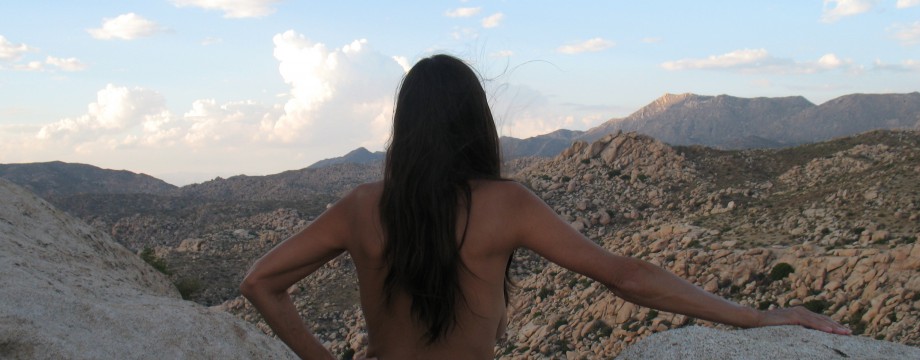
Bears Ears XXVIII
2024-05-31
We’re here in Bears Ears National Monument in southeastern Utah. We have backtracked to Monarch, where we think the Monarch Canyon trail is, after getting misdirected and lost.
An old peaceful looking, Santa appearance of a guy is walking down the two track road with a tall Gandalf-like walking stick. Perhaps Santa is on vacation. He smiles and affirms that we are in the correct spot.
At the trailhead, the off duty wizard has a fun little trailer with a generator humming.
We stop for lunch. While we munch, the New Mexican couple show up. We’re glad that they are not still wandering lost. They comment on the two oddly placed pieces of wood that showed us the way out. They too are grateful. (See the previous post: “LOST Looking for Monarch”)
We slip down the steep sandy slope which walls the riparian area where called the Comb Wash flows.
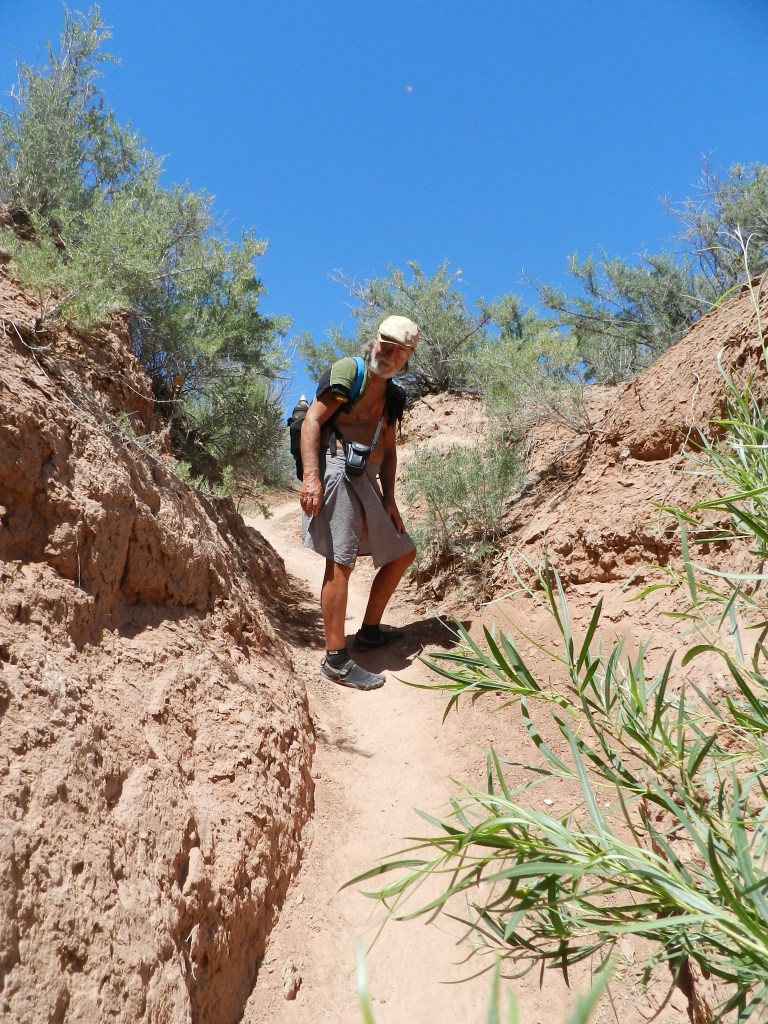
We let them go ahead, so we can follow at a distance nude. We will take our time and make more distance from them, as we go along and better savor the trail.
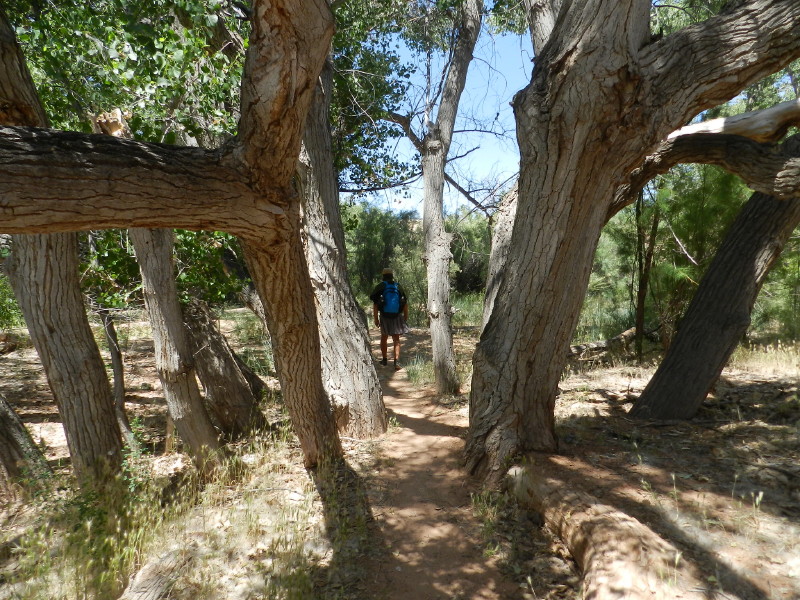
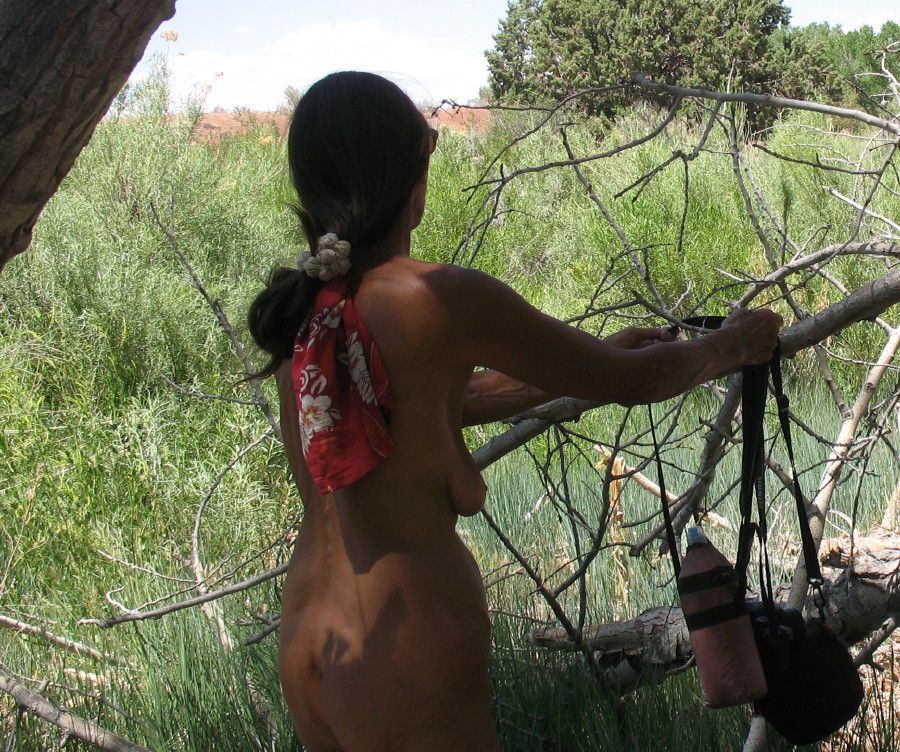
After walking through the forested basin of the Comb Wash, at a distance that seems far enough from Santa Claus, we disrobe.

It feels good, cooler and we get a renewed sense of being on our way to a new adventure and better in touch, because of the experiences of our skin.

The trail is a well-marked. The floor is carpeted with white fluffy droppings from the cottonwood trees. It is like snowfall, as it floats around, traveling haphazardly to earth. Where people walk, it is dispersed making a clear trail.

There is even a line of cairns on a flat smooth rock surface.

These markings keep the landscape less disturbed and our walk less hazardous.

Vegetation changes within the canyon walls. The path meanders and flows gently up and down, side to side. It is around noon and getting hot. It is noticeably pleasant under the occasional shade tree, which breaks the warm radiant heat on our skin.

After a time, we hear voices and place kilt and sundress upon our liberation. The couple and their corgi dog are found underneath a juniper tree. They are like shadows and sitting on a large worn rock. They have already visited and explored. They are heading back soon, most likely.

They are obviously enjoying themselves, as we begin to climb up to the ruins. This rock formation is massive!

Soon, we can see, under an incredible colorful ledge, the monarch’s lair in the distance. It has round towers, kivas. It is fortress-like.

Hanging at the edge of a cliff, it would be difficult to get there, but this trail climbs and then heads along the ledge toward the ruins. We begin to discover pictographs, the more ancient painted literature of the older inhabitants. Then, we find petroglyphic scratching, as well.

Apparently the walls of buildings extended all the way down here along the trail, like row houses, at one time. We look at figures.

Symbols appear.

There are plenty of hand prints on the walls along the way.

The ruins are roped off.

Access to the larger, more intact ruins would be difficult, if we did want to violate the rope’s message.

It is probably for safety, as well as preserving the work being done to restore and excavate this historical treasure. Still, I am tempted by my curiosity. I can see treetops above a drop-off behind the ruins. Water is getting in there and has ponded. Is there a spring, or under this overhand, was there a leaky roof, a diversion, or a catchment?

The pics are fun.

There are higher figures on the wall next to holes for wooden vigas and for climbing.

This must have been two or three stories tall along this indentation. Moki steeps need to go someplace.

These fortresses were built when Medieval Europeans were building theirs, even when Vikings were raiding the coasts of the English, Scots and Irish. They hadn’t learned of metal craft, like pounding iron. They hadn’t been killing each other by the thousands either. They had crafts, art, society, and good health. They had an undependable climate at times, however, drought. They had to make due, and be ready for the next difficulty, store food, know seasons, cooperate, irrigate and respect with knowledge of a fragile landscape. Perhaps modern man could learn something from these so called primitive’s history.

We hear the couple leaving below, calling at the dog.

We’ve kept covered at the site, above them. Most likely this time of year and considering the heat, there should be no problem to walk back nude and expect no encounters with other walkers. We get comfortable.

After enough exploring and photo taking, we head back down the steep trail and take over their shady spot for a snack, to sit and rest.
There is supposed to be a pond of water. Our guidebook writer says that the only dependable water he has found in the Comb Ridge is here.
There is an alternate trail that appears to run along the canyon’s bottom. It disappears into the bushes. The pond is probably pooled at the base of the cliffs.
Finding our way to a probably quiet pond in the forest, we’re finding poison ivy.
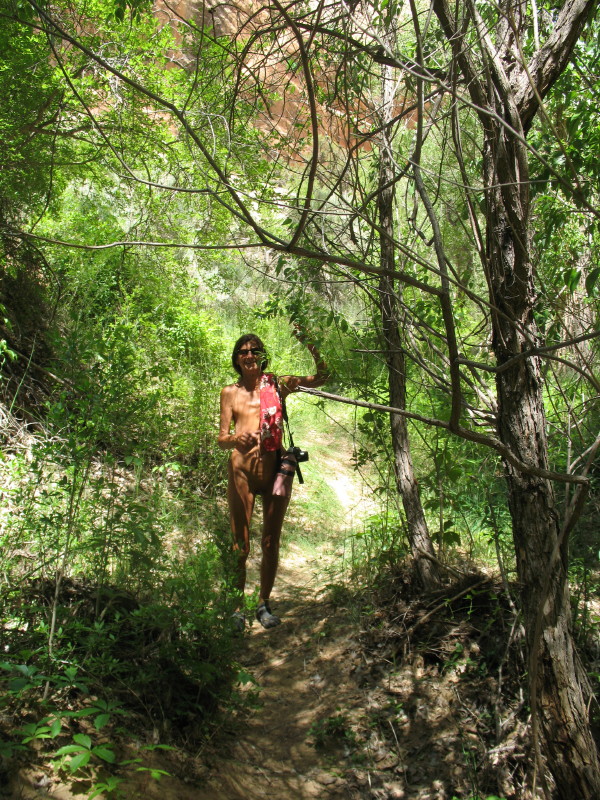
We decide to take the high road trail to avoid it. Up and slippery down, we arrive.

It is more water than we have seen since leaving the river. It is big enough to be a swimming hole, but we decline. It isn’t flowing and clearly clean. The cliffs, fall into the water, making a colorful entertaining back drop.

Along with the happy vegetation that surrounds the oasis.

When we reach the spot on the trail near the gentle Santa’ camp; we stop in the snow to cover-up, and then disrobe once again at our SUV.
The original plan for the day was to also walk Procession Panel’s Canyon. There are 174 stick figures on a wall there. They apparently seem to be all after a couple of deer representations. In the heat, the popular trail is not likely to be populated. At this time however, we feel that it is too hot to climb across solid rock, no shade, up to the procession. Nope, not today. We have seen several high quality photos of it.
We drive back to camp, with the air-conditioning on, to park in our little patch of shade under the lone tree.

I am on the forum of FreeRangeNaturism.com often, if you would like to converse.
© The owners of TheFreeRangeNaturist.org as of the year 2015 declare. Unauthorized use and/or duplication of this material without express and written permission from this site’s author and/or owner is strictly prohibited. Excerpts and links may be used, provided that full and clear credit is given to TheFreeRangeNaturist.org with appropriate and specific direction to the original content.
 The Free Range Naturist
Dear Free Range,
Who is the maker of the grey kilt you wear? Perhaps it’s even homemade. It looks light-weight. I imagine both donning and ditching are easy to do with it.
Ryan
LikeLike