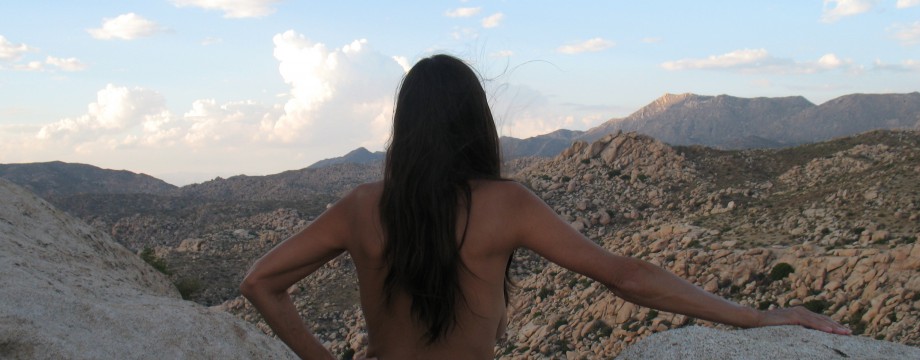

One spring afternoon, as I stood alone, naked to the air, and gazing at the majesty of the nearby Catalina Mountains, I heard an odd drone. As the volume increased, I realized a desert bee swarm was approaching. Against the turquoise backdrop, a ghostly misty black cloud was floating my way.
Alarmed by the warnings in the news media, wholly naked and defenseless, no place to run, my mind raced. A buzz equal to the bees ran up my clothes-free spine, my body becoming alert, my intellect struggling with the impulse of fright and flight. “They say to stand still, or do I run?” In a moment, I reviewed my childhood experience. A friend knocked a beehive on a branch with a stick and I watched as he then stood still being ruthlessly attacked 34 times. Brain lightning rapidly gave me a plethora of thoughts, “There’s nowhere to hide out here.” “Maybe they’ll veer off.” “Maybe I’ll be lucky.” Immersed in this swarm of thoughts, with surrender, I squatted down like the small bushes around me and awaited fate.
The intensity of the drone increased as I watched. They were coming right up the rugged two track road that I had been walking. My mind still racing, “Don’t vibrate fear; they’ll pick up on fear.”
An ominous shadow began to pass around me, an odd light, like a solar eclipse, mysterious. The threat passed above, perhaps a dozen to 20 feet above the ground. It continued on its way, fading.
I sighed as the peaceful stark silence of the desert returned. All I heard was the crunch of my feet meeting sand.

My beekeeping, mesquite-honey-producing friend tells me that bees will react to protect territory. When traveling in swarms, they are on a mission and have no sense of territory to defend. Bee experts say that when swarming, as long as you don’t disturb them, Africanized bees are minimally dangerous.
In the numerous encounters with swarms since that day, sometimes several in a single spring walk, I have stood still and watched them passing overhead.
So-called “killer bees” are for the most part the same as common honey bees, but with more aggressive attitudes. They will attack sooner, chase people further (up to a quarter mile), and do so in greater numbers than honey bees. But their stings are the same as those of honey bees; it’s just the sheer number of potential Africanized bee stings that makes them more dangerous.
Not all the hives I’ve encountered are the same. There were those early fears that all our local populations would breed into terrorists. My friend tells me that his locals have indeed become more aggressive, but not like the original “KILLERS.” It’s turning out that, reciprocally, many killer bee hives are being toned down, too, through interbreeding with calmer varieties and by natural selection calming them down over multiple generations due to their having here fewer natural predators to defend against. This has been seen in Puerto Rico, and seems to be happening in the United States, too.

That isn’t to say that aggressive hives aren’t out there. I once had a favorite spot on a slab of rock in a small canyon wash, which was ideal for lying back and baking gently naked in the sun, smelling the passing bouquets of desert flora in restful communion with my nature. As I lay on my perch one day, a pesky bee disturbed my quiet. Its personality wasn’t the calm, busy, minding-its-own-buzzness type.
Somehow, the little critter projected anger. On my next visit more of these cranky folk were about my solitude rock. Just upstream, under a slab where occasional water falls during rains, I discovered the nest. There was not enough room for us both in that canyon.
I find that when nude, my awareness is heightened, my relationship to my surroundings altered. The prickly desert, where my sleeve or pant leg might get caught on a bush is approached more reverently without clothing. My body in infinite ways will detect and avoid sharp objects. There is a fascinating knowledge in our skin of space, which clothing can never know. I walk quieter and mindful when naked. I listen. I don’t haphazardly brush my way through flowering plant life as with the protection of clothing, and am thus not as apt to disturb those feasting on the pollens. Nature minds its own business, when left to that. So do bees.
My partner DF and I walk around bees. Last summer, we found an aggressive group inhabiting the soil in the middle of the trail, digging small holes.

We walked around them. The Africanized bees are feisty; some who live in the Earth are not.
Hiking nude in bee environments is not a problem, but can become one. Just remember what Winston Churchill said about fear. Then enjoy your nude desert hike while aware of your surroundings, listening for buzzing, watching for bees, and being ready to walk calmly to another location if needed.

© The owners of TheFreeRangeNaturist.org as of the year 2015 declare. Unauthorized use and/or duplication of this material without express and written permission from this site’s author and/or owner is strictly prohibited. Excerpts and links may be used, provided that full and clear credit is given to TheFreeRangeNaturist.org with appropriate and specific direction to the original content.
 The Free Range Naturist