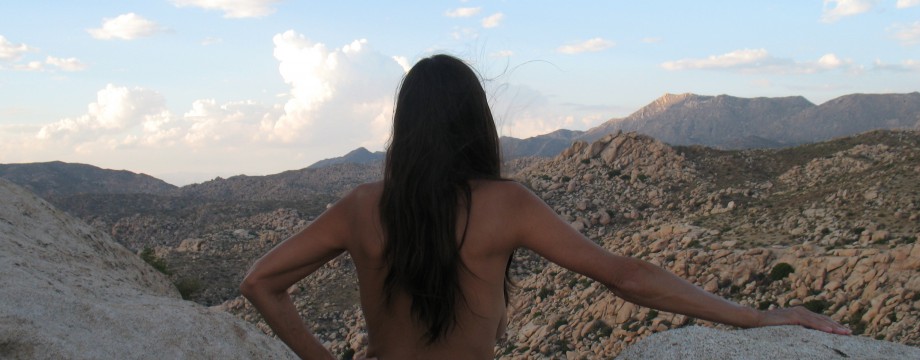
Bears Ears XXXII
2024-06-04
We have just visited the popular House on Fire ruins. If you haven’t read it, I suggest going there first for context. See the story here:
The plan is to head on up the trail from the ruins and into the canyon where the crowds rarely go. There, we can look for any more signs of ancient life and explore in natural pleasant nudity with little chance of being interrupted by others. There is always something fun and of interest in these remarkable canyons. We figure that we’ll spend another hour or so, up the trail and then return, depending on the heat and comfort.
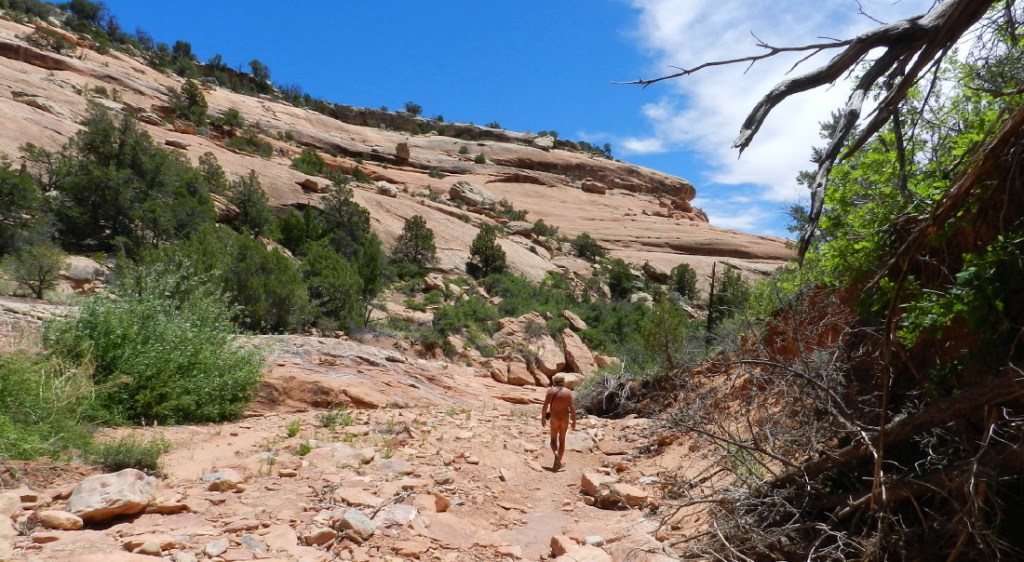
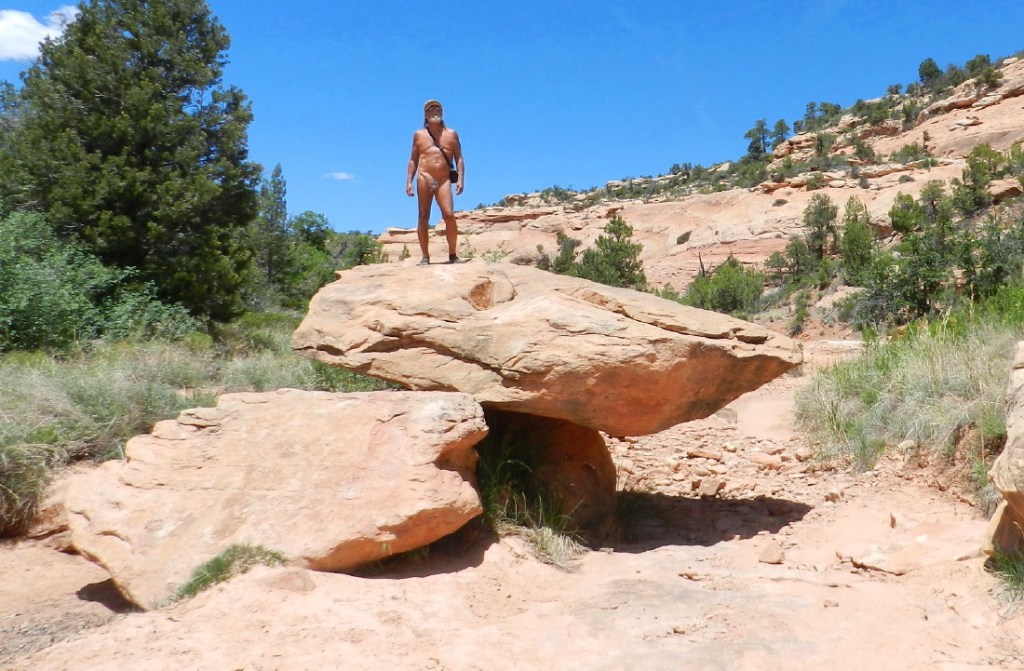
As soon as possible, we are once again naked in the sun, but maybe within sight of those people who are above, near the ruins, hidden in the brush.
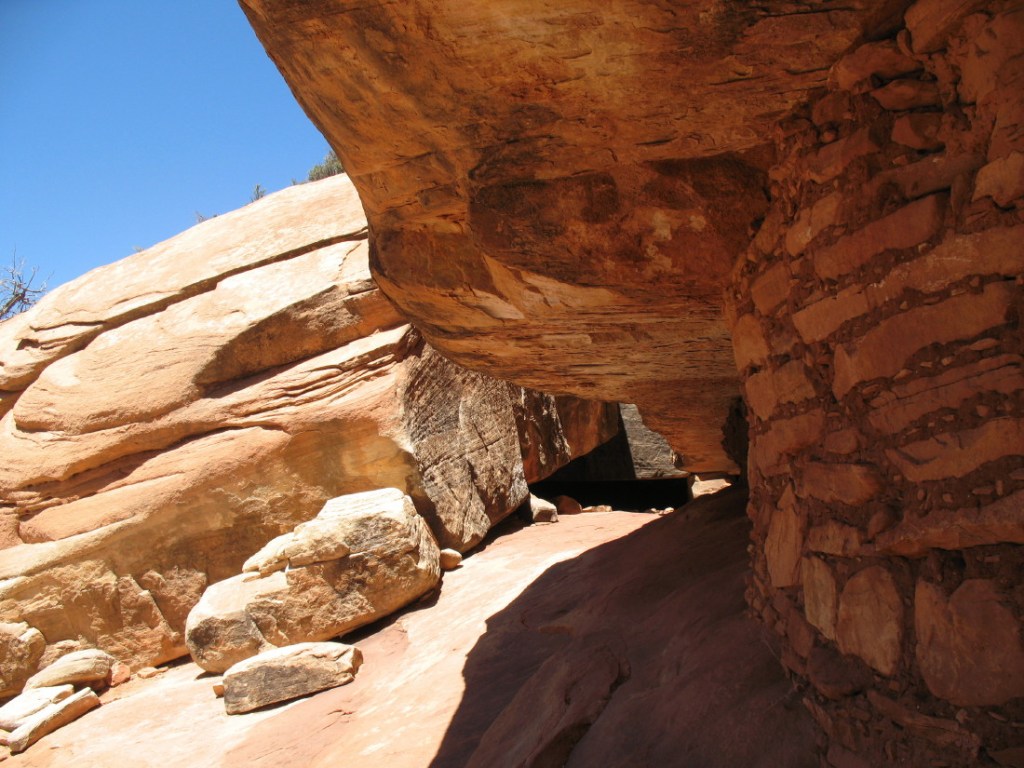
These ruins! Discovering pictographs and petroglyphs is addicting. We know that there are likely more. This area was just too rich and big to not be inhabited by more ancient farmers.
We search, looking for clues. It quickly becomes like gold fever, but we aren’t the only ones with the thirst for discovery. We follow odd little off trails. There are other’s footprints in search of the thrill of discovery.
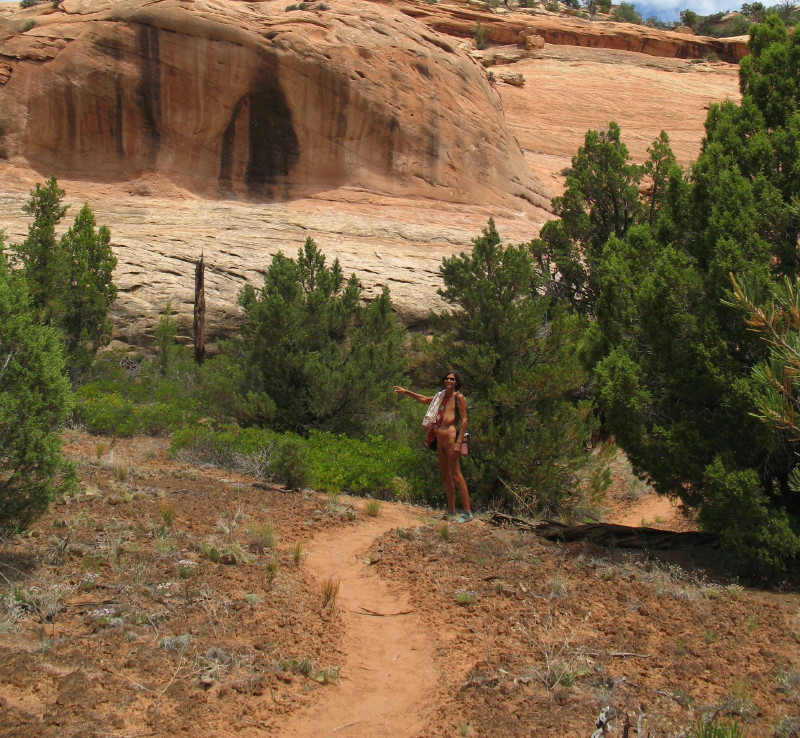
Sometimes the remnants of certain vegetation associated with people’s propagation can be a clue. A protective arch above are points used for significant ruins. Positioning of the sun’s warmth on a rock face can reveal a ruin. Strategic positions can have placements. These were central gathering places, but they had to come with nearby huts, farming, safety and community. Much of the farming was seasonal, dictated by spring rains and summer monsoons. Elevation can be a factor, more ideal to grow corn, but a nasty winter’s stay. People had to move to different homes, the life of transhumance. Many of these ruins have been discovered and still look like they were suddenly abandoned, but these may have just been left as is, in order to come back during the seasonal migration.
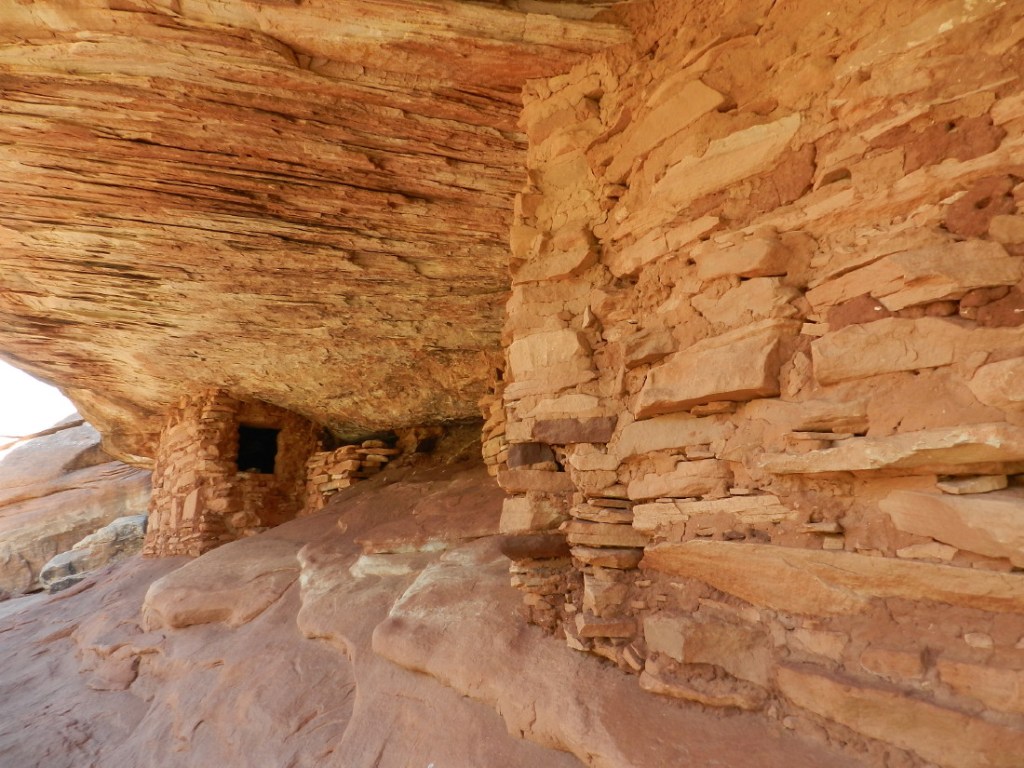
A pile of arrow chards or pottery would confirm suspicions of habitation. The puzzle, clues to a mystery and solving them can be very satisfying for us. We’d like to photograph and feel like explorers, or archeologist.

We’d like to imagine what people ate, and when and how much. We’d like to see what they saw and found in their times.

To project ourselves back to a home long ago, to understand, learn and appreciate a life involved deeply with nature.

We have a continual obvious revelation about how we feel, as all of this, past and present, relates to naturism. We put ourselves in others shoes, living undressed, unencumbered, unashamed, with a sense of normalcy, living in tight little family huts and rooms in fortresses. Why were all of the ceilings not tall? Was it about practical space, inhabitant’s stature, less space to heat and so less precious fuel? How did they sleep? I remember attending a Native peasant wedding in Cochabamba, Bolivia back in the mid-1970’s. I had met up with some local guys in a bar there and soon found my way invited into the revelry. This “gringo” was treated like a visiting rock star in their small town. When I accepted a guitar and played a poor rendition of “Not Fade Away” they were impressed. Late that night, the family’s men brought us to where we were all staying, a room off of a house. I was given the honor of sleeping in the only bed, where others were curled up on the dirt floor. The thing was, the normalcy was four of us packed like sardines, feet to head, into a small bed. Customs and normalcy have varied through the ages. I found it warm, but dusty enough that I left before sunrise, to better sleep on a park bench in a drizzle, waiting for a bus to a ferrocarril, a sort of train. I can imagine people, like these, going through winter packed into small rooms, long ago.

All of the museums tend to depict men with their waists wrapped in cloth and women in full length dresses. All of these pictures came after white men had arrived. All of the ancient art on the walls, pictograph and petroglyphs show genitals, hanging below figures. They look decorative. Our experience has found that a poncho, or cloak, is very practical when it is cold. A body will adapt naturally to weather. It may need a little help from time to time. There is little to no evidence of clothing, just costume, other than shoes, bits of cloth. Cloth that was laborious to produce and to clean with precious water.

In the University of Arizona museum of natural history, the depicted ancient natives were notably nude. They are no longer nude in any museum that I have been to in decades. I’d suppose that children on field trips would notice nudity and then some director going on about “inappropriate.” I’d call it an inconvenient truth.

We explore until we have a little lunch in the shade of an overhang, near a series of currently dry waterfalls.

It is quiet. Plants curiously grow out of rock walls sideways next to us. I pick up my camera and shoot a picture in a lazy fashion.

It is getting hot and we have to drive several miles to Blanding and then back to get gas and ice to spend a week in the cooler weather of the mountains of Bears Ears, Grand Marsala National Forest. The days are very long at this time of year, but there is much to do and ground and adventure to cover today.
Were tired of moving camp so often and so are looking forward to a place in the forest for a couple of days and just take it easy, no goals and no destinations.
Along this canyon with many bare rock slopes and walls, we find curious stones. I’m thinking geodes, but closer examination shows me otherwise.

The trail is easy. Along it, sage glitters and glistens silver in the sun.
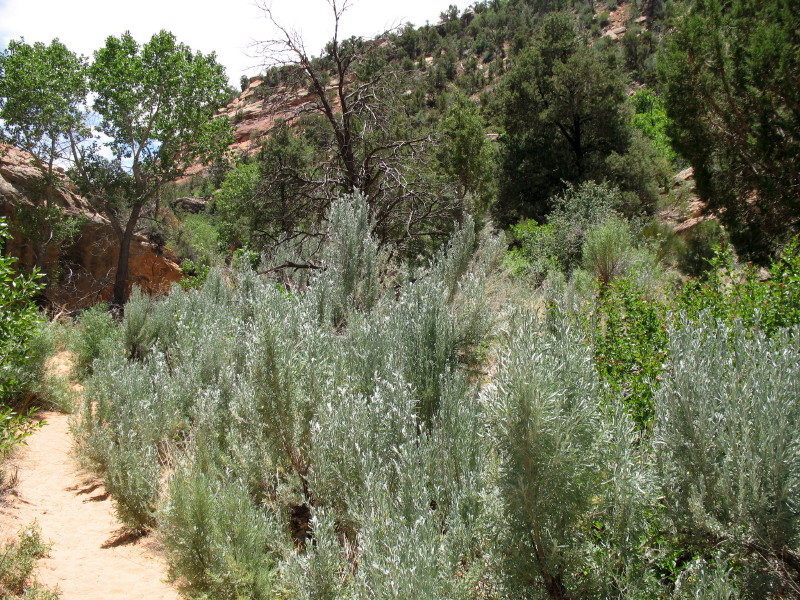
Foliage smells menthol, a treat. Everywhere here, the rock formations are fascinating.
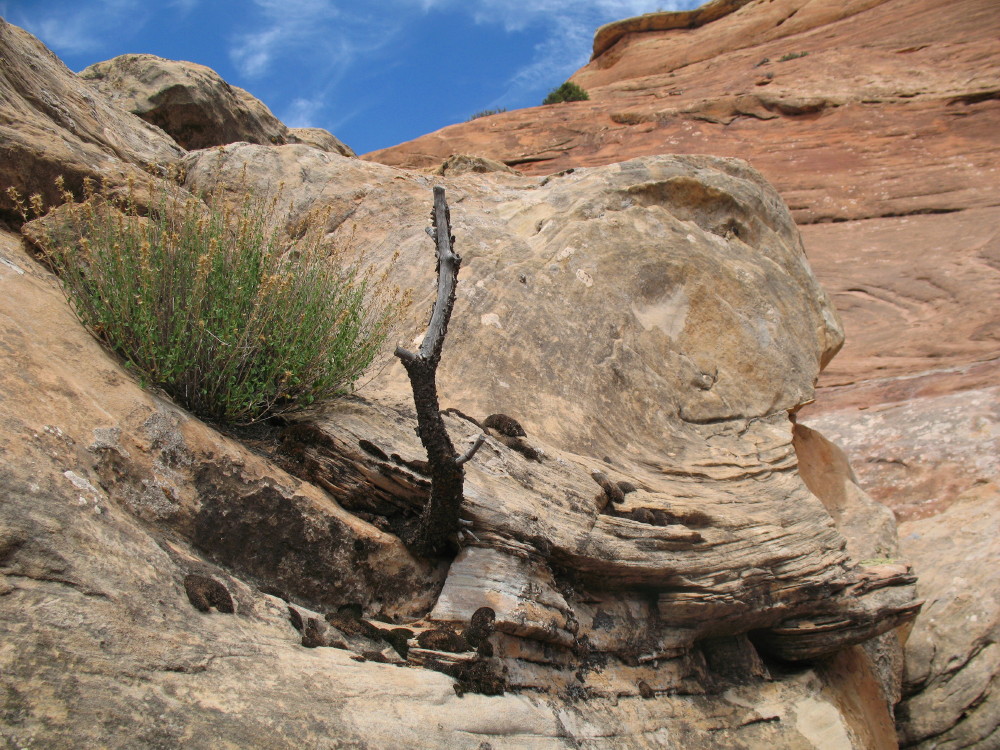
There are large odd shaped rocks, looking like petrified ancient dinosaur poo.

Plants somehow tap into barren sands.

Bushes and trees love crevasses for a taste for life and end up as a bonsai.

In this dry season, the last residues of water are drying puddles. The tadpoles had better mature very soon; they are crowded into the diminishing environment and resources of their birth.

Flowers are blooming at this slightly higher elevation (5500 to 6500 feet) and many plants and foods can grow.

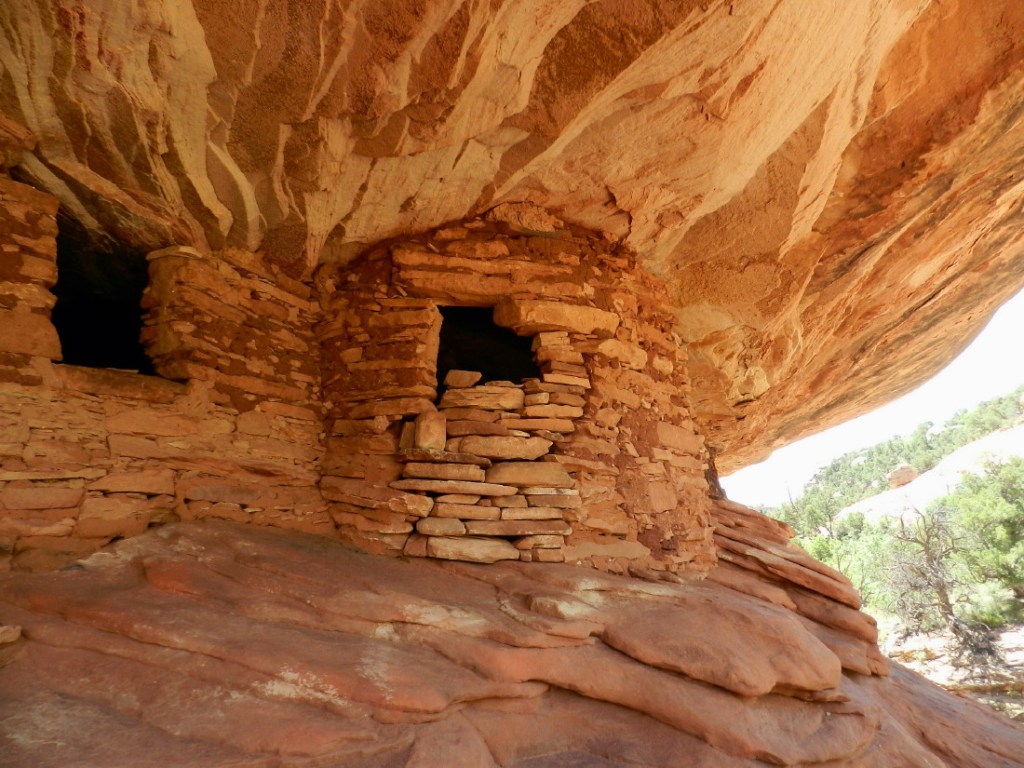
Nobody is at the ruins, so we take a break to enjoy it all to ourselves, again. I try flashing a light inside the rooms, to better see what’s there.

Masonry style has been done in different times by different architects, or masons.

Uneven floors and debris may mean a storage center.

On the way back, we encounter a group with older kids and two adults, six people. We hear their noise and reluctantly gather coverings around us. A short distance further, we hear a loud couple shouting at each other. It is apparently normal conversational volume for them. As we approach, they are smiling. He makes a greeting and in jest questions, “Is it worth the price admission?”
“Yes….”
I am on the forum of FreeRangeNaturism.com often, if you would like to converse.
© The owners of TheFreeRangeNaturist.org as of the year 2015 declare. Unauthorized use and/or duplication of this material without express and written permission from this site’s author and/or owner is strictly prohibited. Excerpts and links may be used, provided that full and clear credit is given to TheFreeRangeNaturist.org with appropriate and specific direction to the original content.
 The Free Range Naturist